From Pilgrims to Pioneers: Tracing German Roots in America’s Thanksgiving Story
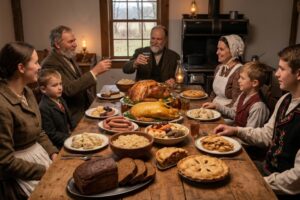
While English colonial narratives tend to dominate the Thanksgiving mythos, German-Americans brought with them an old-world appreciation for harvest festivals—Erntedankfest, their traditional celebration of thanks.

This autumn observance emphasized gratitude, community gatherings, hearty foods, and church services focused on blessings received throughout the year. When German settlers arrived in Pennsylvania, the Midwest, and the Great Plains, they carried these customs with them and naturally blended them into local American life. Over time, their rhythms of giving thanks—rooted in family, faith, and the fruits of the soil—helped guide the emerging American spirit of harvest celebration.
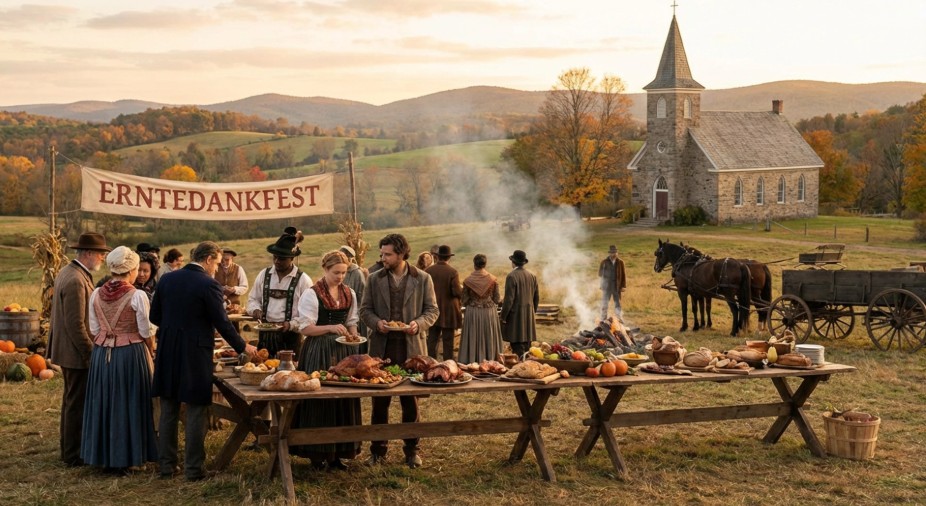
Beyond celebrations, German farming know-how dramatically shaped the agricultural backbone of the young nation. German immigrants introduced advanced crop rotation, efficient barn designs, new food-preservation methods, and hardy livestock breeds that improved both yields and food security.

Their meticulous, almost scientific approach to agriculture spread rapidly across frontier settlements. These innovations didn’t just feed growing communities—they laid essential groundwork for the agricultural abundance modern Americans now associate with Thanksgiving tables overflowing with produce, breads, sausages, and seasonal desserts.

And then there’s the food—because no discussion of Thanksgiving is complete without it. German-Americans expanded America’s palate long before the holiday had a set menu. They contributed sausages, smoked meats, spiced breads, apple dishes, sweet rolls, and the kind of root-vegetable comfort foods that feel right at home beside turkey and stuffing.

In many regions, early Thanksgiving dinners featured sauerkraut alongside roast fowl, a tradition that still survives today in pockets of Pennsylvania and the Midwest. These German culinary fingerprints helped shape an American feast that is richer, heartier, and far more diverse than the simplified storybook version we often imagine.
https://historicaldigression.com/wp-content/uploads/2010/11/the-first-thanksgiving.jpg
https://www.loc.gov/static/classroom-materials/immigration/images/german4_1.jpg

Most Americans picture Thanksgiving as a uniquely English-American tradition—Pilgrims in buckled hats, Native Americans, a harvest feast, and a legendary turkey. But behind the familiar story lies a surprising truth: German immigrants played a remarkable, often overlooked role in shaping America’s Thanksgiving customs, foods, farming techniques, and attitudes toward gratitude.

Long before pumpkin pie crowned the dessert table and football dominated the afternoon, German pioneers were planting crops, building communities, and sharing traditions that blended into what we now celebrate as Thanksgiving. Their influence is woven quietly but deeply into America’s cultural fabric—one hearty feast, one farmstead, and one frontier settlement at a time.

So grab a plate, pour a mug of cider (or maybe a crisp Oktoberfest brew), and let’s time-travel through how German roots helped cultivate America’s thanksgiving spirit long before Thanksgiving became a holiday.


The Pilgrim Story We Know… and What’s Missing

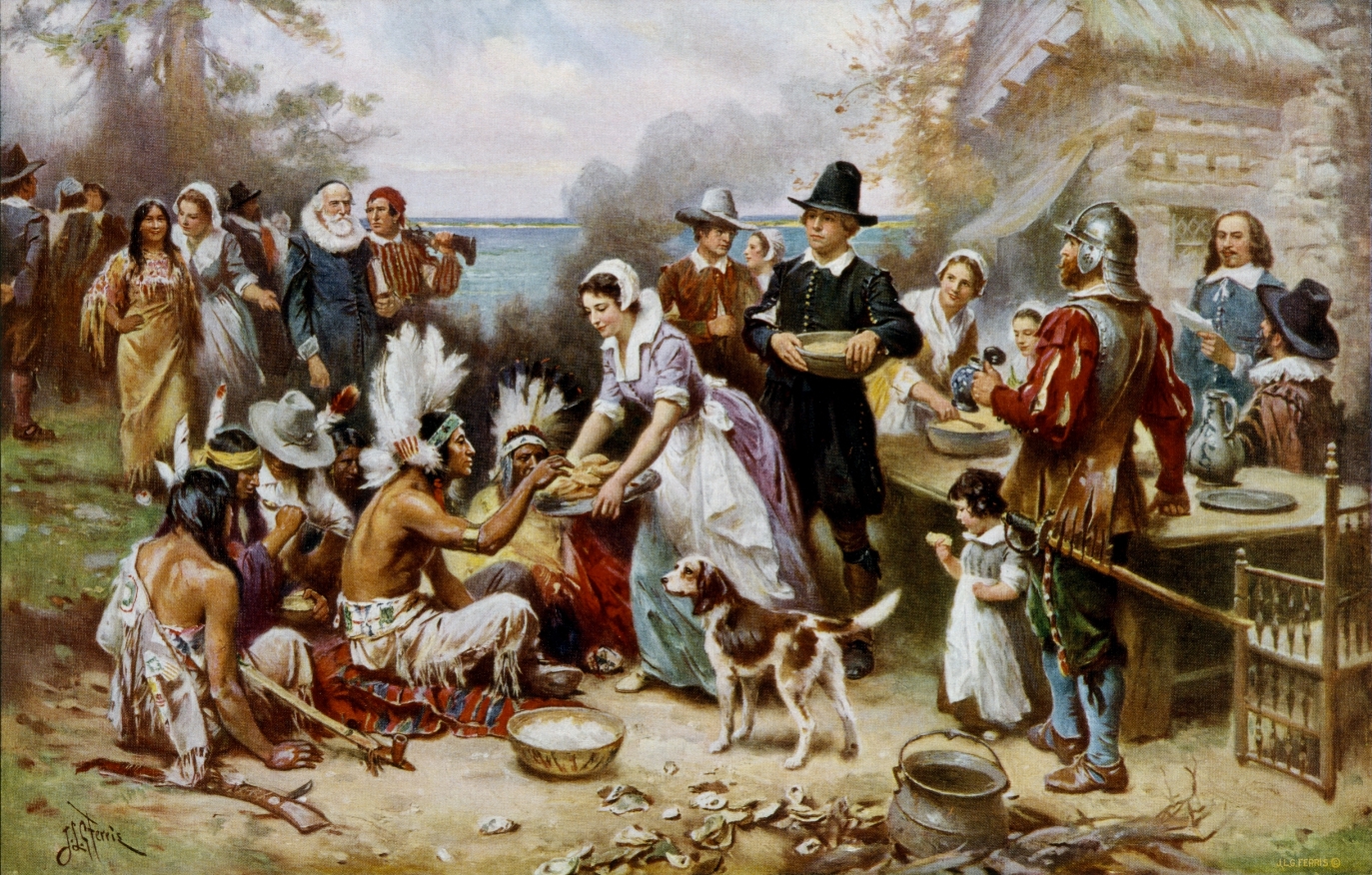
We all know the basics: In 1621, English Pilgrims and Wampanoag people shared an autumn harvest meal in Plymouth—a symbolic moment of cooperation and survival. But here’s what textbooks often skip: the Pilgrims were not the only Europeans contributing to early American harvest traditions.

In fact, while the Pilgrims were building Plymouth Colony, German-speaking settlers were already living, farming, and worshipping in parts of what is now the United States, especially in New York, Pennsylvania, and along the East Coast. Their agricultural know-how, communal feasts, and deep spiritual focus on gratitude paralleled many themes later associated with Thanksgiving.
https://sigalmuseum.org/wp-content/uploads/2017/09/10-300x206.jpg
https://cdn.thecollector.com/wp-content/uploads/2023/04/history-of-the-pennsylvania-dutch.jpg

» Read more

Erntedankfest and Thanksgiving: A Celebration of Gratitude

Harvest festivals unite people worldwide to thank nature for its gifts. Erntedankfest in Germany and Thanksgiving in the U.S. share gratitude but have their own traditions.

Erntedankfest happens in early autumn in Germany. It’s a time of joy, mixing faith with community spirit. In contrast, American Thanksgiving is a national holiday for family and big meals.

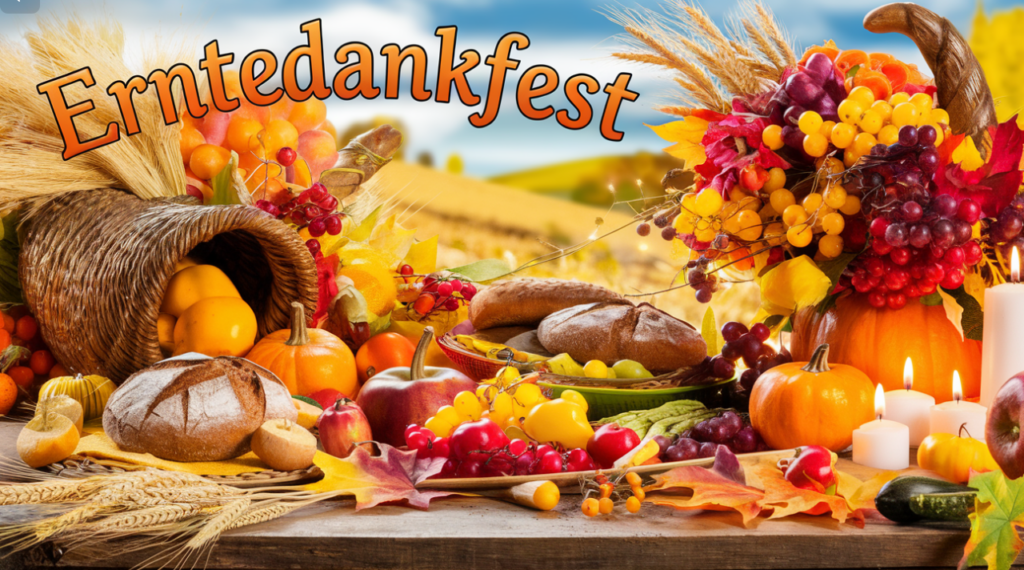
A vibrant Erntedankfest celebration scene featuring a traditional rustic harvest table adorned with colorful autumnal fruits, vegetables, and freshly baked bread. Nearby, a lush cornucopia overflowing with seasonal produce in warm hues, surrounded by decorative wheat sheaves and candles. The backdrop includes a picturesque countryside landscape with golden fields and a bright blue sky, evoking a sense of abundance and gratitude.

Erntedankfest has church services and parades, with local twists. American Thanksgiving is about turkey dinners and football games.

Both festivals celebrate thankfulness and togetherness. They help us think about our blessings and bond with family and friends, connecting us all.

Key Takeaways

  • Erntedankfest is usually celebrated in early autumn in Germany
  • American Thanksgiving is a national holiday in November
  • Both festivals focus on gratitude for the harvest
  • Erntedankfest often includes religious services and parades
  • American Thanksgiving is known for family gatherings and turkey dinners
  • Both celebrations emphasize community and thankfulness

Understanding the Rich Heritage of Harvest Festivals

Harvest festivals in Germany and Thanksgiving in the USA have deep roots. They come from ancient times when people celebrated the end of the growing season. Over time, they have mixed religious and cultural elements, becoming beloved holidays in both countries.

Ancient Agricultural Roots

Harvest festivals started long ago, when people celebrated the end of harvest. In Germany, these early events led to Erntedankfest. In the USA, Native American harvest rituals helped shape Thanksgiving.

Evolution into Modern Celebrations

Erntedankfest in Germany began in the 17th century, thanks to Protestant churches. By the 19th century, it was celebrated all over Germany. Thanksgiving in America started in 1621, with a feast in Plymouth, Massachusetts. Both have become national holidays, each with its own traditions.

Religious and Cultural Significance

Today, these festivals mix spiritual and cultural elements. Erntedankfest in Germany happens on the first Sunday in October. It includes church services, parades, and community events. American Thanksgiving, on the fourth Thursday of November, focuses on family and food.

Both holidays celebrate gratitude, unity, and the role of farming in our lives.

“Erntedankfest and Thanksgiving remind us to appreciate the abundance of nature and the hard work of farmers who bring food to our tables.”

» Read more

How German immigrants embraced the American Turkey on Thanksgiving

Thanksgiving, a quintessential American holiday, has a complex and fascinating history that intertwines with the tales of immigrants who brought their traditions across oceans. Among these pioneers were German immigrants, whose gradual adoption of turkey as the centerpiece of the Thanksgiving feast unfolded over generations, leaving an indelible mark on the evolving culinary landscape of America.

When German immigrants arrived in America, they brought with them a rich history of traditions, including their own version of a Thanksgiving celebration known as “Erntedankfest.” In Germany, Erntedankfest typically takes place in September or October, marking the end of the harvest season. It is a time for communities to come together and express gratitude for the abundance of the harvest, often featuring church services, parades, and festive meals.

Upon settling in America, German immigrants found themselves in a new cultural landscape, and one of the first adjustments they made was to the timing of Thanksgiving. In the United States, Thanksgiving is celebrated on the fourth Thursday of November, a date that holds historical significance dating back to the early days of the nation. The German immigrants embraced this new tradition, blending elements of Erntedankfest with the American Thanksgiving festivities.

» Read more

Harvesting Gratitude: Exploring the Rich Traditions of Erntedankfest, Germany’s Thanksgiving

We are already in the autumn month of November and if you think that you are just in time to learn about Germany’s Thanksgiving… sorry you missed it already.

Erntedankfest, the German equivalent of Thanksgiving, is a joyful celebration of the harvest and a time to express gratitude for the year’s bounty. While the exact date varies depending on the region, it is typically held in September or October and sometimes into early November.

In some parts of Germany, Erntedankfest falls on the first Sunday in October, often coinciding with the first Sunday following Michaelistag or Michaelmas (September 29th). In other regions, the celebration takes place on the first Sunday in November.

Just know that in the heart of Germany, nestled between the golden hues of September and October, lies a celebration that echoes with the same spirit of gratitude as its American counterpart.

Erntedankfest, known as Thanksgiving in Germany, is a festival that transcends time, weaving together ancient roots and modern traditions.

Join us on a journey through the bountiful fields of Erntedankfest, exploring its origins, traditions, and the vibrant tapestry of symbols that define this festive occasion.

» Read more