The Case for 60 Million: How Anglicization and Assimilation Expanded German Heritage
GERMAN HERITAGE USA | AFFILIATE DISCLAIMER: This post may or may not contain affiliate links which means we may receive a commission for purchases made through links. We will only recommend products that we have personally used or that we truly trust. Learn more on our Private Policy and Disclaimer Page located under our Terms Of Service tab above.
For generations, Americans of German ancestry have been everywhere—and almost nowhere at the same time.
They helped build towns, farms, breweries, churches, universities, businesses, and entire regions of the United States. German words entered American English. German customs became American traditions. German family names filled phone books, gravestones, and town records—often without anyone realizing their origins.
And yet, when modern Americans are asked about ancestry, German heritage often seems quieter than expected.
But what if that quietness doesn’t reflect absence at all?
What if it reflects something far more powerful: successful assimilation, cultural blending, and identity expansion?
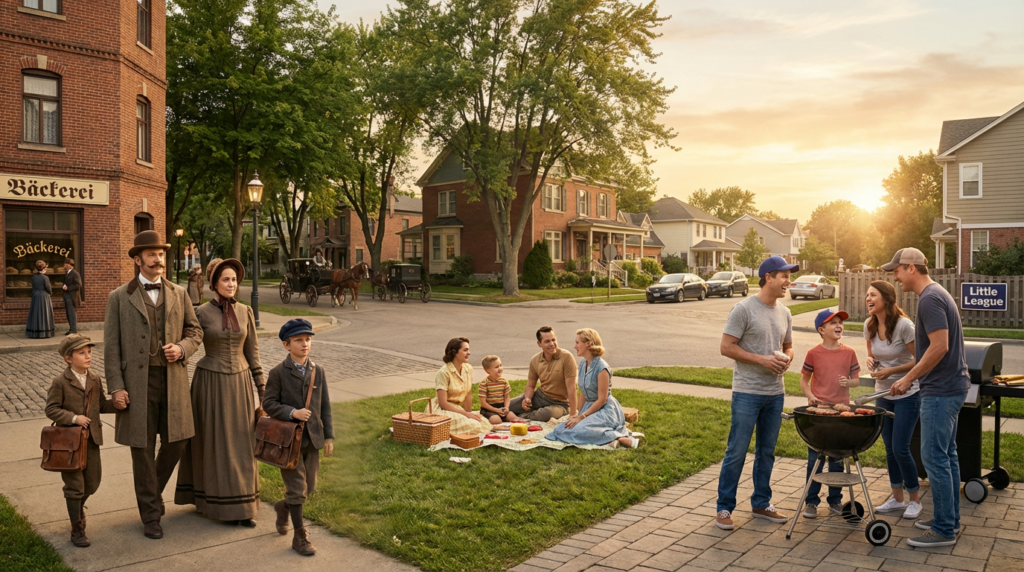
Recent self-reported U.S. Census and American Community Survey (ACS) data places Americans identifying as German at roughly 40–41 million people, already making German ancestry the single largest self-reported European heritage group in the United States.
However, when we examine how ancestry is reported, how names changed, how families blended, and how identity simplified over generations, a compelling case emerges:
Americans of German ancestry may realistically exceed 60 million people—making German heritage the largest national ancestry group in the United States.
This article explores how and why that happened—not through disappearance, but through integration.
The Starting Point: What the Census Actually Measures
Before diving deeper, it’s important to understand what U.S. ancestry data does and does not measure.
The Census and ACS rely on self-reported ancestry, not genealogical verification. Individuals answer based on:
- What they know
- What they were told
- What feels most relevant to their identity
- What fits on the form
Ancestry is not ranked by genetic percentage, nor does it capture every ancestral line. In many cases, respondents list only one or two ancestries—even when their family history is far more complex.
That matters deeply for German Americans, whose history in the U.S. stretches back centuries and intersects with nearly every other major European heritage group.
Anglicization: When Names Changed but Heritage Stayed

German immigrants and their descendants frequently adapted names for:
- Pronunciation
- Employment opportunities
- Social integration
- Simplicity in an English-speaking society
This process was rarely about erasing heritage. More often, it was about belonging.
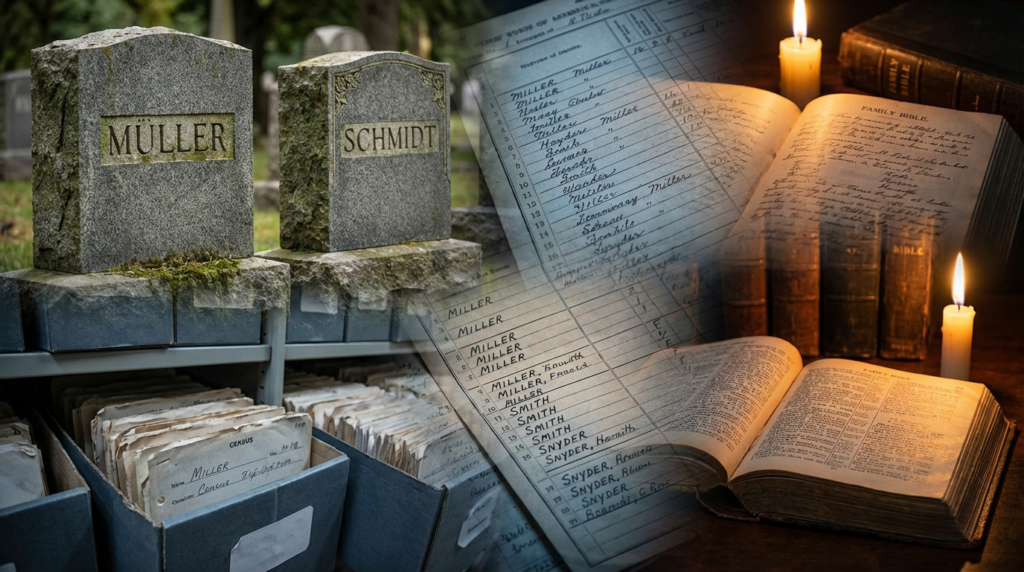
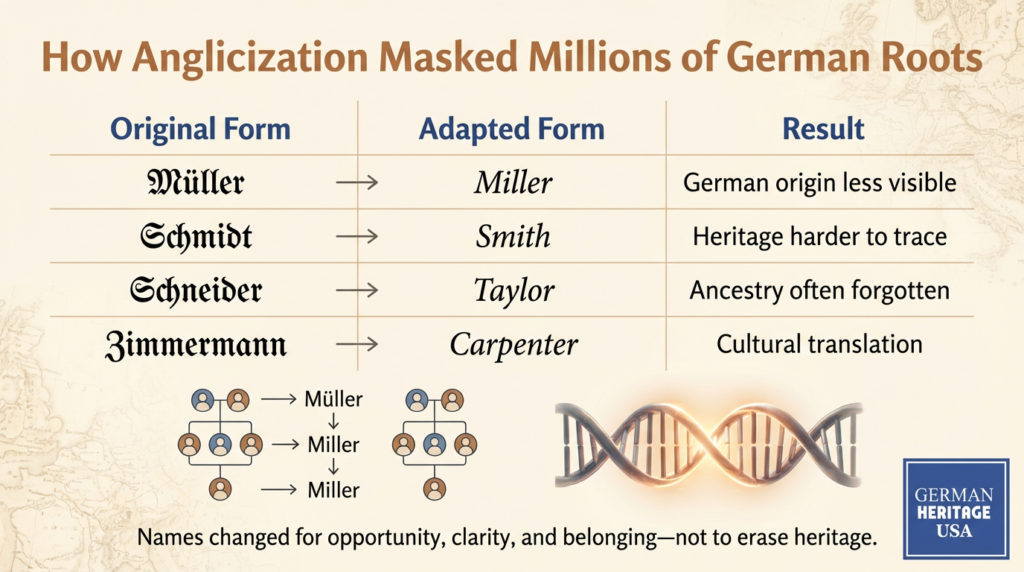
Müller became Miller
Schmidt became Smith
Schneider became Taylor
Zimmermann became Carpenter
Over generations, those changes made German roots less immediately visible, especially to descendants who grew up with English surnames and little exposure to German language.
As one historian famously noted:
“Names didn’t disappear. They translated.”
The infographics included throughout this article visually demonstrate how millions of German descendants remain genetically and historically connected—despite name evolution.
Language Shift and Cultural Blending Across Generations
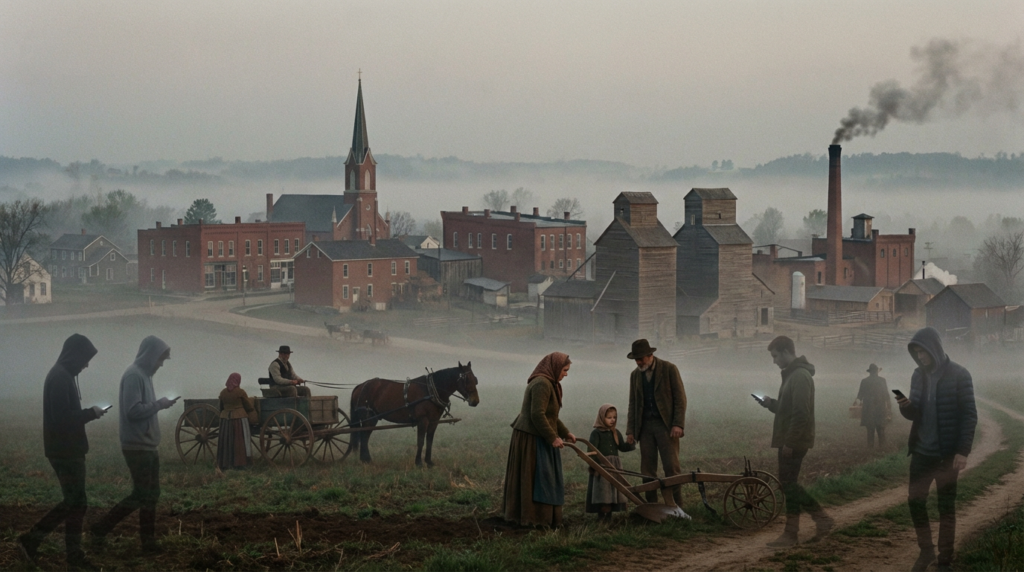
But as generations passed, English naturally replaced German in daily life.
This wasn’t cultural loss—it was cultural blending.
Traditions survived in different forms:
- Food
- Music
- Work ethic
- Family structure
- Community organization
What changed was how visibly “German” those traditions appeared.
By the mid-20th century, many families still practiced German-influenced customs but no longer labeled them as such. Heritage remained—but quietly.
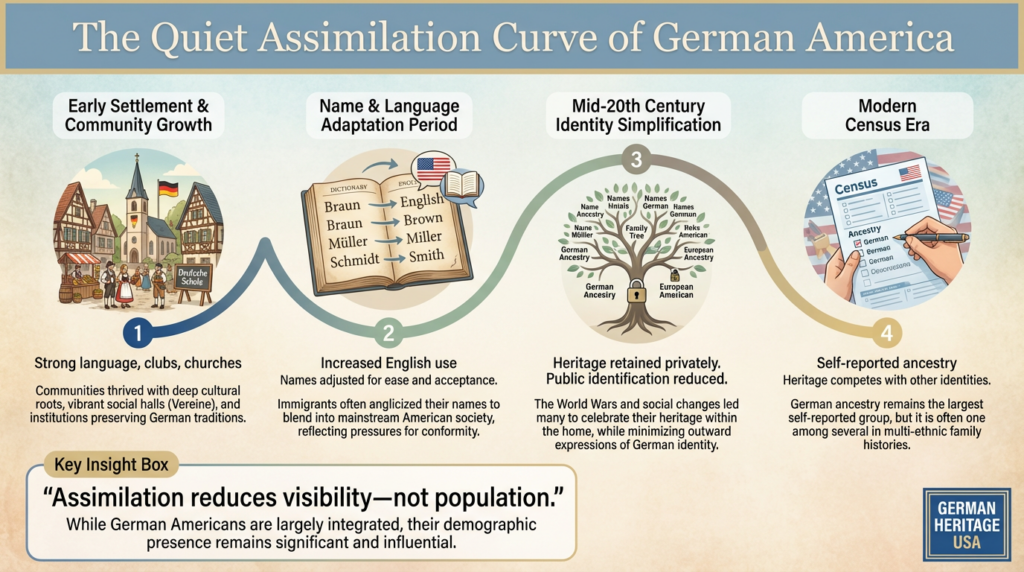
As your “Quiet Assimilation Curve” infographic shows, assimilation reduced visibility, not population.
The Census Structure Itself Limits Visibility
Most Census and ACS forms effectively capture only the top one or two ancestries a person chooses to report. That creates an unavoidable limitation.
German ancestry is uniquely affected because:
- It is widespread
- It is old
- It is deeply interwoven with other European lineages
In multi-ethnic families, German often gets displaced by:
- Irish
- English
- Scottish
- Italian
- Or simply “American”
Not because it’s less important—but because it’s older and more blended.
This structural reality alone accounts for millions of Germans not appearing in headline ancestry figures.
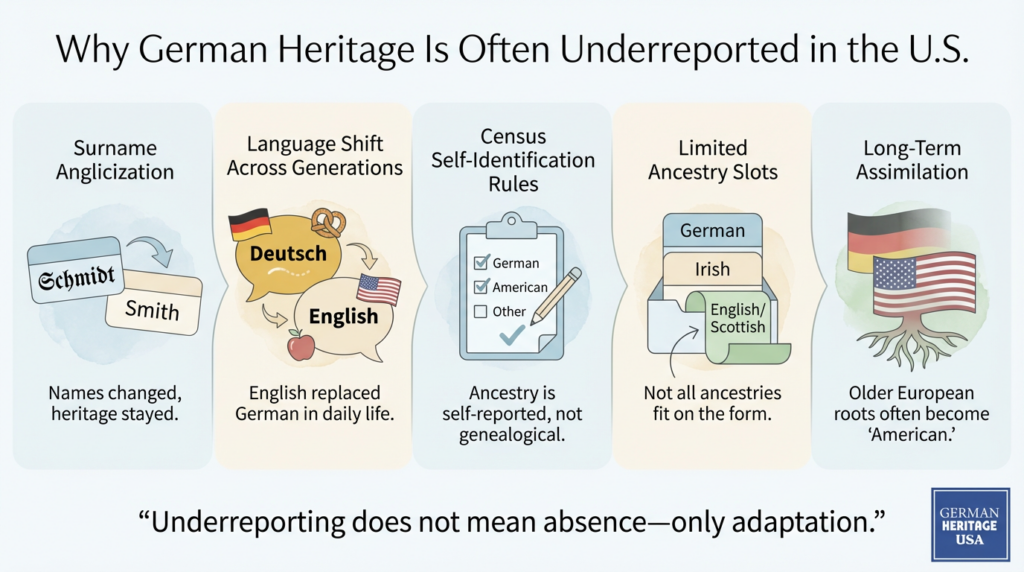
Why German Heritage Is Especially Prone to Underreporting
Your second infographic lays this out clearly, and the data supports it:
- Surname anglicization reduced recognition
- Language shift reduced cultural labeling
- Self-identification rules rely on awareness
- Limited ancestry slots force prioritization
- Long settlement history leads to “American” identity
Taken together, these factors form a powerful explanation for why German ancestry is often underreported—but never absent.
As the infographics throughout this article rightly states:
“Underreporting does not mean absence—only adaptation.”
A Quiet Historical Influence: How the World Wars Shaped German Identification
It is also important—carefully and factually—to acknowledge another influence that affected German heritage visibility in the United States: the social climate during the World War I and World War II eras.
These periods were not only global conflicts; they were also moments of heightened national sensitivity. For many Americans of German ancestry, public identification with German culture became less comfortable and less practical, even when family heritage remained unchanged.
During these decades:
- German-language instruction declined rapidly
- German newspapers and institutions faded or transitioned
- Families emphasized English-first identity at home
- Surnames and cultural references were simplified or minimized
In many cases, these adjustments were pragmatic, not ideological. Families adapted to the environment around them, prioritizing stability, opportunity, and cohesion.
Importantly, these shifts influenced how German ancestry was discussed, passed down, and later reported—effects that extended well beyond the war years themselves. Children and grandchildren often grew up with limited knowledge of their German roots, even when those roots were still present.
As a result, modern Census data reflects not a loss of German ancestry, but a long-standing pattern of reduced visibility that began during those eras and continued through subsequent generations.
This helps explain why German heritage can be both:
- Demographically large
- Publicly understated
The impact was subtle, cumulative, and enduring—and it remains part of today’s ancestry reporting landscape.
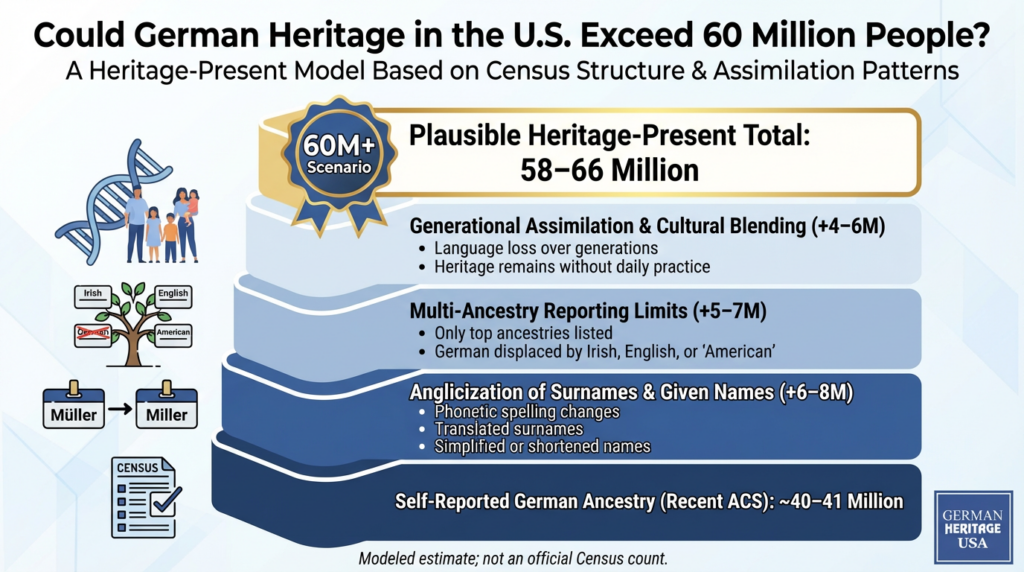
The Heritage-Present Model: Why 60 Million Is Plausible

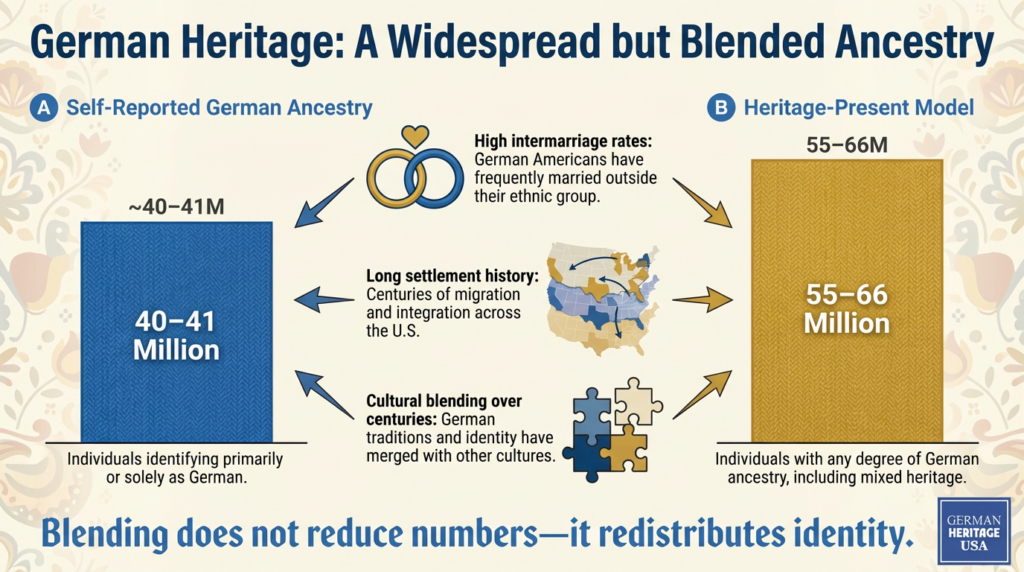
When we step beyond self-reported labels and examine heritage presence, a clearer picture emerges.
Starting with:
- ~40–41 million self-reported German Americans
Then accounting for:
- Anglicized surnames and given names
- Multi-ancestry reporting limits
- Generational assimilation
- Cultural blending over centuries
The heritage-present model—illustrated clearly in your graphics—supports a plausible range of:
58–66 million Americans with German ancestry
That puts German heritage firmly at the top of all national ancestry groups in the United States.
Importantly, this is not a claim of exclusivity. It’s a recognition of scale, longevity, and integration.
German heritage didn’t grow by isolating itself—it grew by becoming American.
Blending Didn’t Shrink German Heritage—It Expanded It


One of the most important takeaways from this research is that blending increases reach.
High intermarriage rates didn’t dilute German ancestry—they distributed it.
Long settlement history didn’t weaken identity—it normalized it.
Assimilation didn’t erase heritage—it embedded it.
As one demographic principle reminds us:
“A heritage that blends successfully doesn’t vanish—it multiplies.”
That insight sits at the heart of why German ancestry remains both everywhere and understated.
A Heritage Hidden in Plain Sight
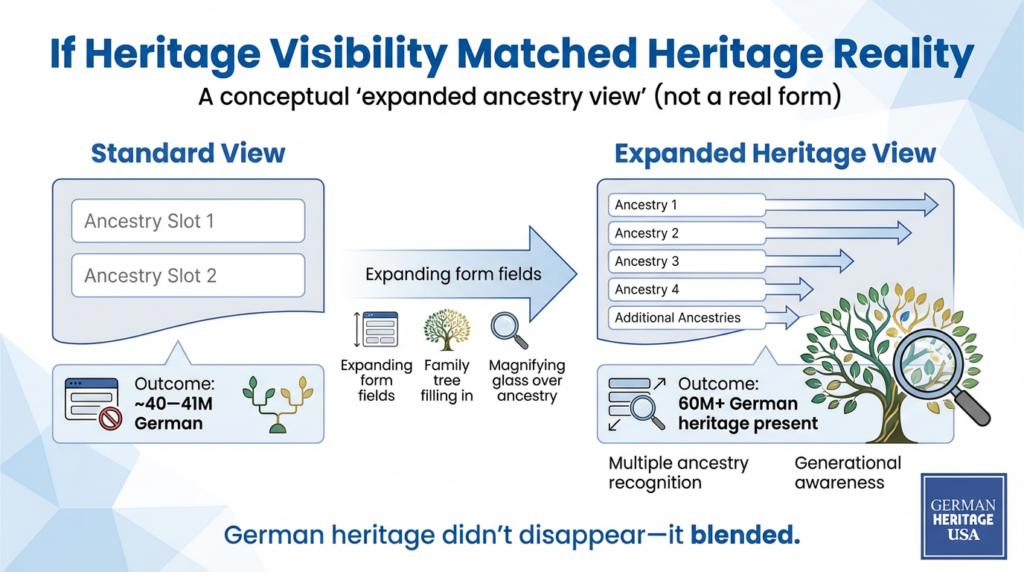
The final infographic in this series poses a powerful question:
What if heritage visibility matched heritage reality?
If Americans were encouraged to list:
- Multiple ancestries
- Older generational roots
- Heritage affected by name or language change
The numbers would tell a different story—one already supported by history.
German heritage would emerge not as a niche identity, but as a foundational one.
Conclusion: The Largest Heritage Story America Isn’t Always Telling
German heritage didn’t disappear.
It blended.
It adapted.
It helped define what “American” means.
And today, when we step beyond surface labels and examine heritage presence, a powerful conclusion emerges:
Americans of German ancestry have become the largest national heritage group in the United States—potentially exceeding 60 million people.
Not through isolation.
Not through separation.
But through integration, contribution, and belonging.
That is not just a demographic story—it’s an American one.