What Really Happened at the First Oktoberfest? The Forgotten Story Behind Germany’s Greatest Tradition
GERMAN HERITAGE USA | AFFILIATE DISCLAIMER: This post may or may not contain affiliate links which means we may receive a commission for purchases made through links. We will only recommend products that we have personally used or that we truly trust. Learn more on our Private Policy and Disclaimer Page located under our Terms Of Service tab above.
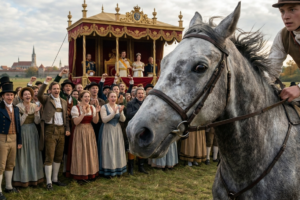
If you traveled to Munich on Wednesday, October 17, 1810, looking for the first Oktoberfest, you would have found horses, thousands of spectators, and a royal pavilion beside a meadow. You would not have found today’s beer halls, Ferris wheel, or a mayor shouting “Ozapft is!”
The wedding that inspired it had taken place five days earlier, on Friday, October 12. Munich spent the intervening days celebrating. Then, at the end of the festivities, the Bavarian National Guard staged a horse race outside the city gates. That October 17 race is the event Munich identifies as the first Oktoberfest, although its participants were celebrating a marriage, not opening a festival with two centuries of history behind it.
Who were the newlyweds? Who won? What did people eat and drink? And did Albert Einstein really change the light bulbs? The answers are livelier—and occasionally less certain—than the legend.
First, meet the bride and groom
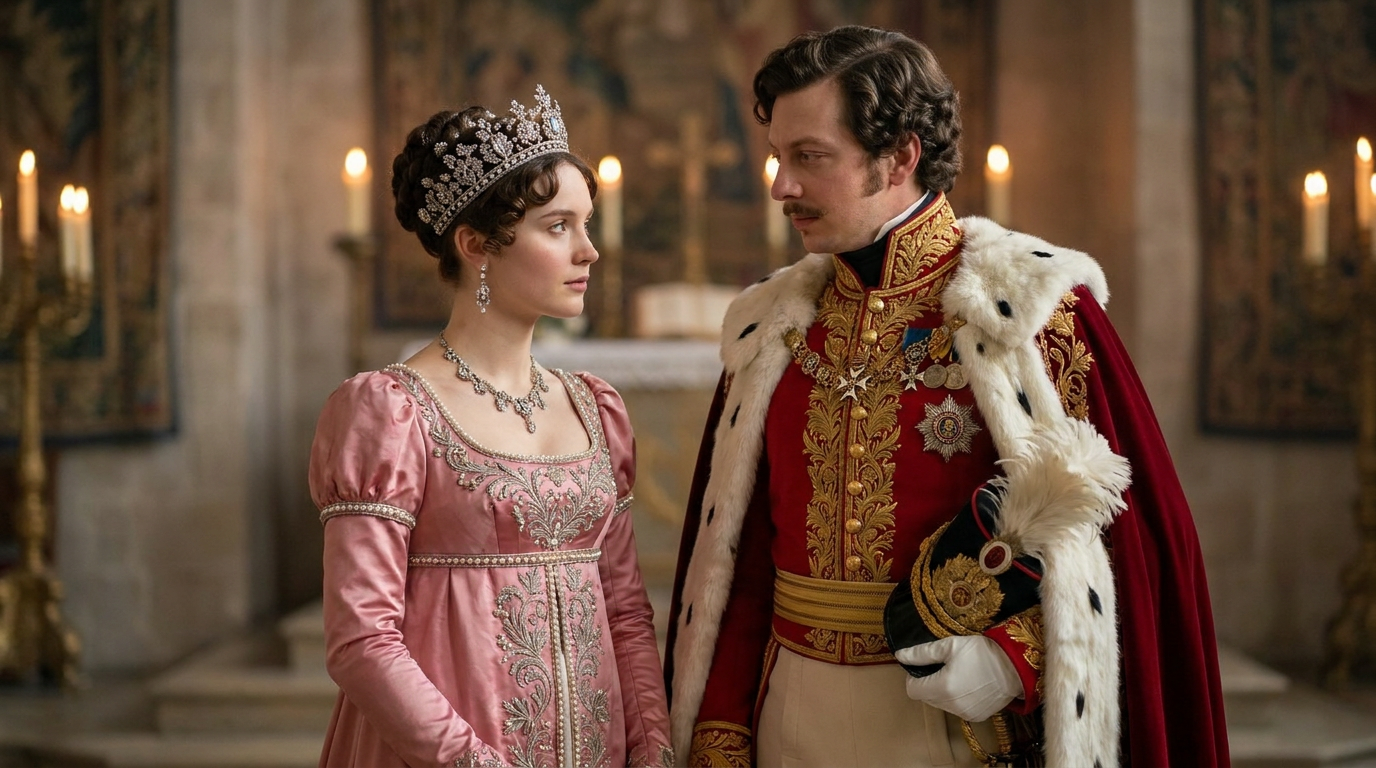
Crown Prince Ludwig was 24; Princess Therese was 18. Ludwig was born August 25, 1786, and Therese on July 8, 1792. He would not become King Ludwig I until 1825. In 1810, it was his father, King Maximilian I Joseph, who reigned over the young Kingdom of Bavaria.
Therese was the daughter of Duke Friedrich of Saxe-Hildburghausen and Charlotte of Mecklenburg-Strelitz. Ludwig visited the family in 1809 and chose Therese over her sister Luise. Their formal engagement took place February 12, 1810—exactly eight months before the wedding. Ludwig’s father considered the match politically suitable, though he wrote that Therese would bring little money or property into the marriage.
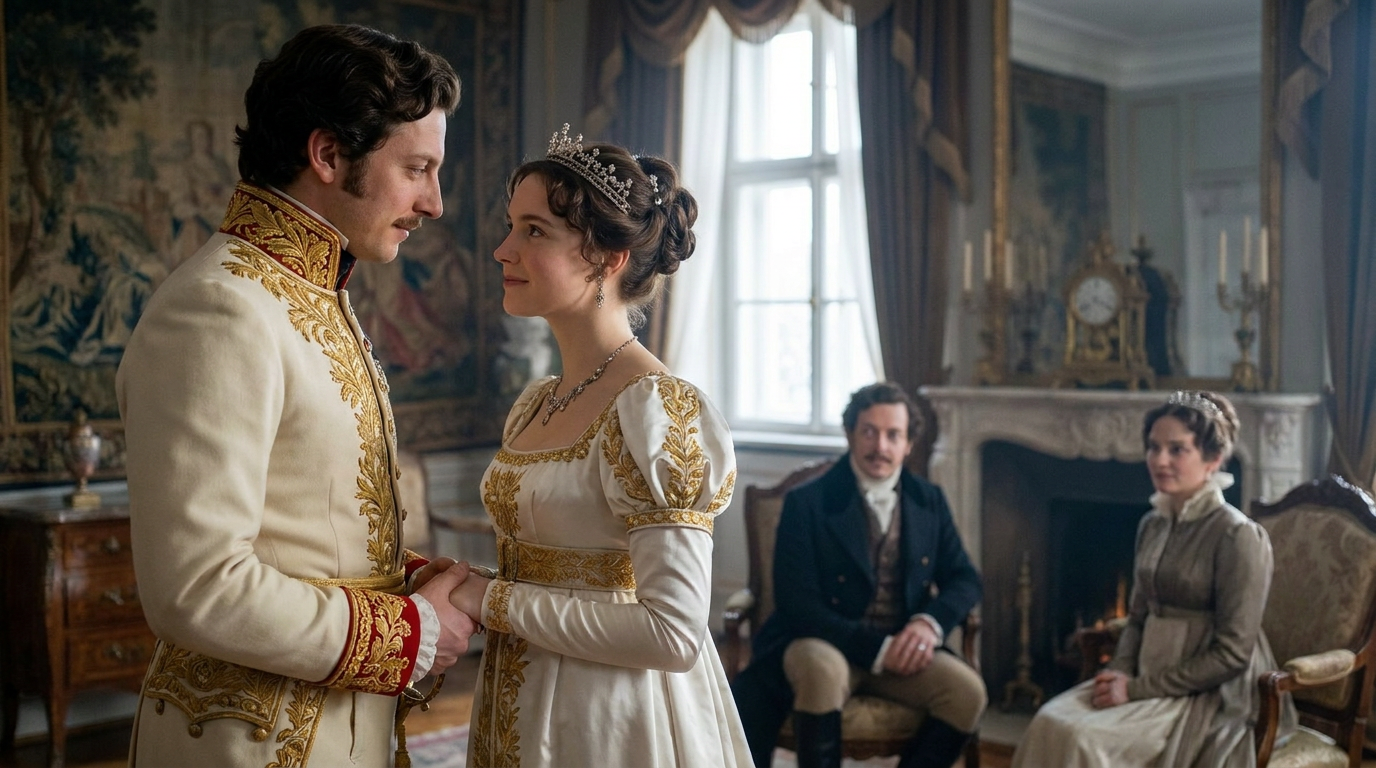
So, was Ludwig wealthy? He was heir to a crown and would later sponsor lavish public art and architecture. But a modern dollar-value estimate of his personal fortune in 1810 would be guesswork. Royal standing, access to court resources, state finances, and private wealth are different things. His father’s remark tells us more about the expected dowry than any invented “net worth” could.
What about their heights? Reliable measurements for the couple have not surfaced in the historical sources used for this article. Ludwig can look shorter in some portraits, but painters chose poses and proportions for effect. A portrait cannot establish whether Therese stood taller than he did.
One physical detail has survived: the Bavarian National Museum holds a pink bridal gown associated with Therese’s wedding, made with silk, silver embroidery, and a high Empire-style waist. The bride of the first Oktoberfest story was not necessarily dressed in the white gown we might imagine today.
Was it a Catholic wedding?
Ludwig was Roman Catholic. Therese was Evangelical Lutheran, and she remained so throughout her life. Their marriage took place on the evening of October 12 in the Hofkapelle, the Catholic court chapel of Munich’s royal residence. So the setting was Catholic, while the marriage joined people of different faiths. The sources do not justify calling Therese a Catholic bride or confidently reconstructing every part of the service.
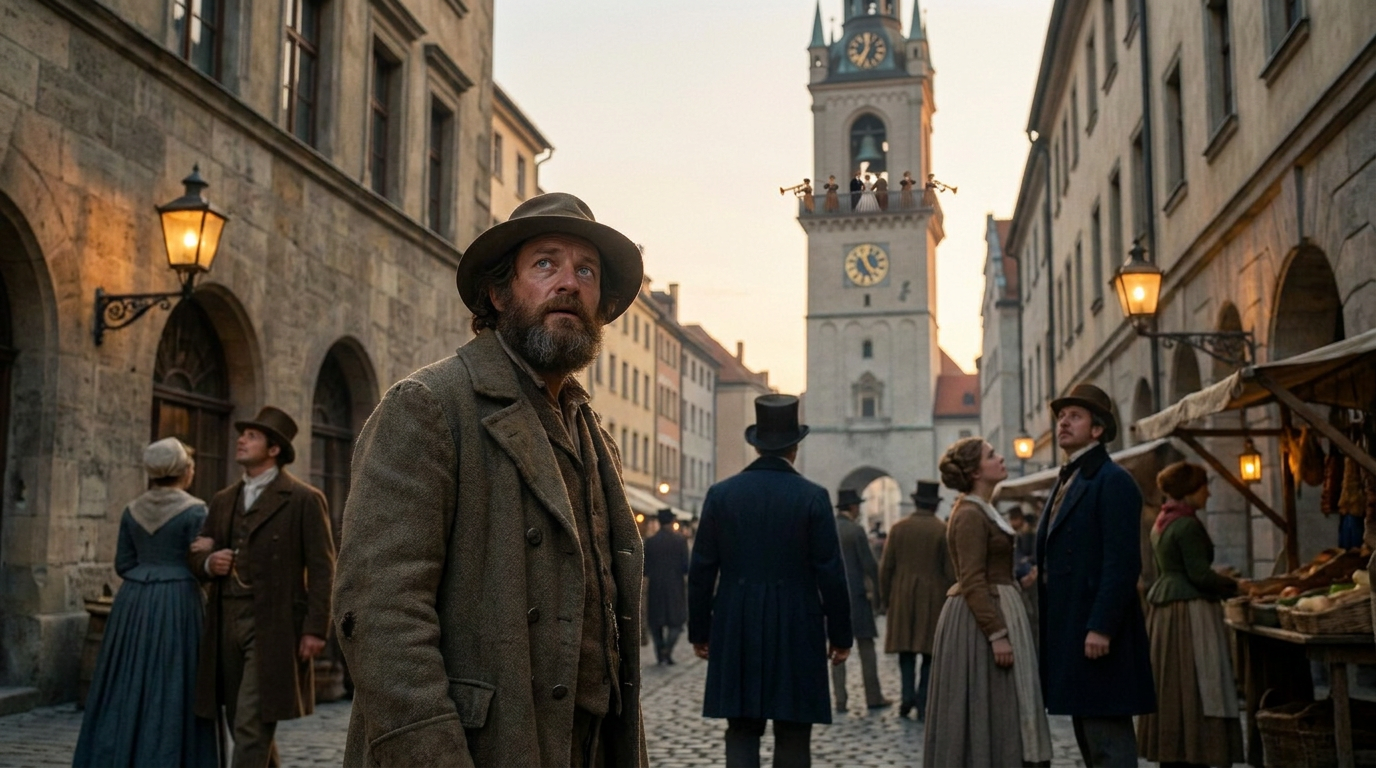
King Maximilian’s name day also fell on October 12. The royal family marked that occasion in the morning and the wedding in the evening. Church bells, cannon fire, choral music in the main square, and trumpets from St. Peter’s tower announced the marriage to the city. That is an impressive soundtrack—but it is not evidence that a modern “oompah” tent band played at the race.
Were there bridesmaids and groomsmen? No source consulted names an American-style wedding party. Court attendants and royal relatives would have had roles, but assigning anyone the title “maid of honor” or “best man” would turn a historical gap into a made-up detail.
What filled the five days?
The answer is bigger than a wedding reception. Munich’s streets were illuminated; citizens gathered for music, dancing, meals, and public festivities. King Maximilian invited around 6,000 prominent citizens to dine and dance in four major inns. Tables were also set up outdoors for the broader public. Bavarian palace historians specifically record food, beer, and Austrian wine being served in the city.
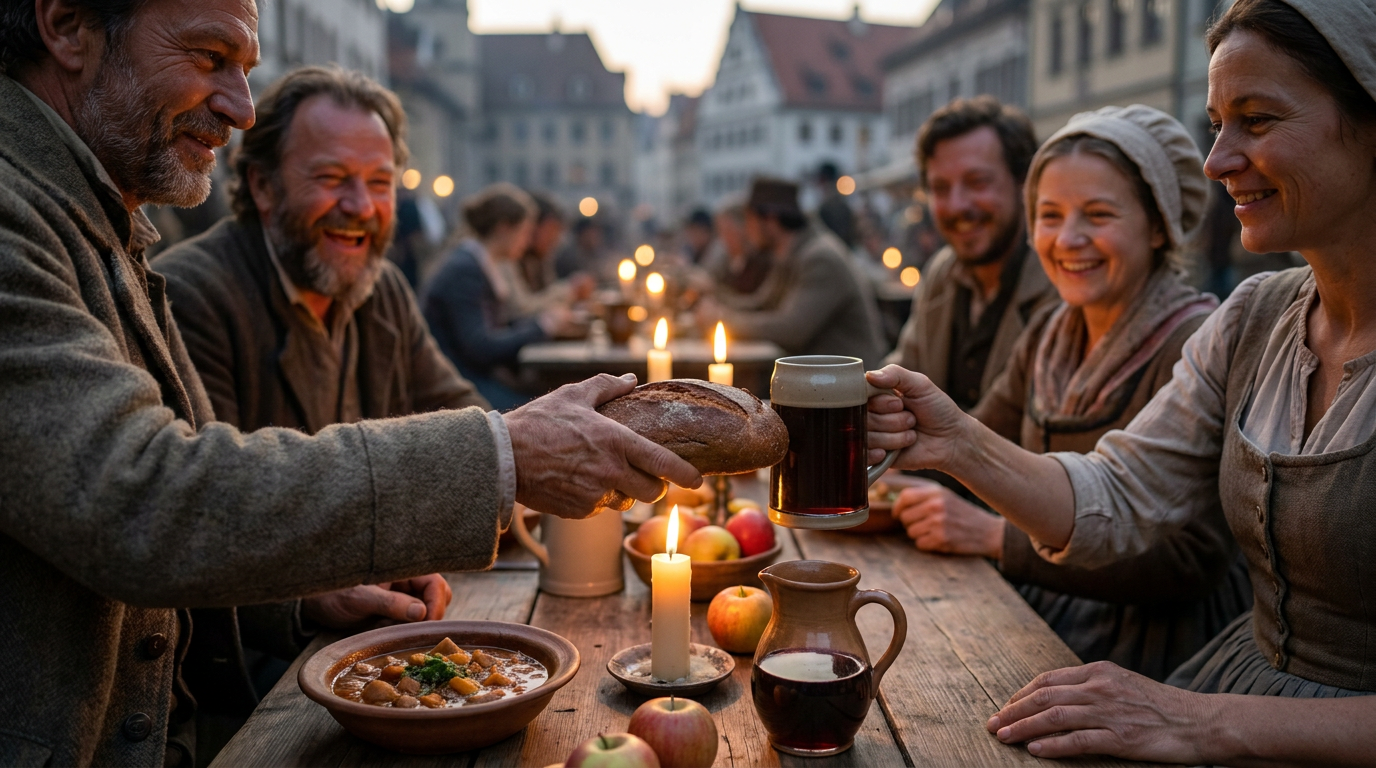
What food, exactly? The surviving accounts located for this article establish public meals but do not give a dependable item-by-item menu for October 12–17, 1810. It would be tempting to write that everyone ate giant pretzels, roast chicken, and bratwurst. Those foods belong in many later Oktoberfest scenes; they cannot simply be copied onto the first wedding week. The festival’s first dedicated roast-chicken operation, for instance, dates to 1881.
And which beer brand was poured? Beer was present at the Munich celebrations, but the cited accounts do not identify the breweries supplying each public table or inn. Hofbräu already existed as a royal brewery; that does not prove its beer was the drink in every 1810 cup. Hofbräu dates its first special beer brewed for Oktoberfest to 1812, two years after the wedding. The familiar Märzen-style festival beer arrived later still in the festival’s evolution.
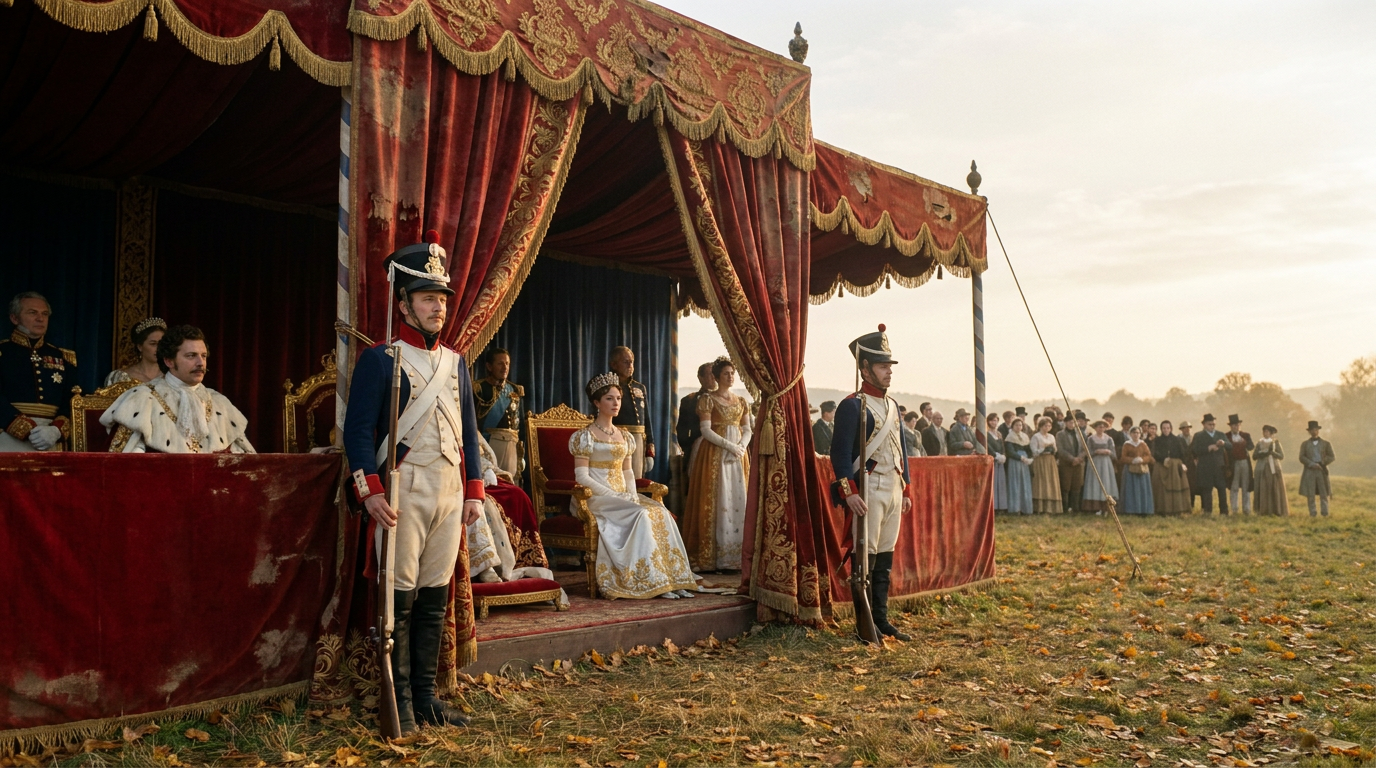
There were VIPs, certainly: the king, the newlyweds, and the royal household. A white royal pavilion stood at the racecourse, reserving a viewing place for the court. Named foreign ambassadors and a complete guest list for race day, however, are not established by the sources here. Do not seat Napoleon in the front row just because his politics shaped Ludwig’s choice of bride.
“The original Oktoberfest had beer in the city and horses on the meadow. The two scenes became one tradition only after Munich chose to celebrate again.” — GERMAN HERITAGE USA
Whose idea was the horse race?
Here the usual one-person origin story needs an extra character. Munich’s official festival history credits Andreas Michael Dall’Armi, a banker and National Guard major, with proposing the public race to the king. Bavaria’s cultural portal adds that a subordinate—a coachman and guardsman named Franz Baumgartner—suggested the idea to Dall’Armi, who obtained approval and organized it. The king approved the plan in early October, leaving remarkably little time before the event.
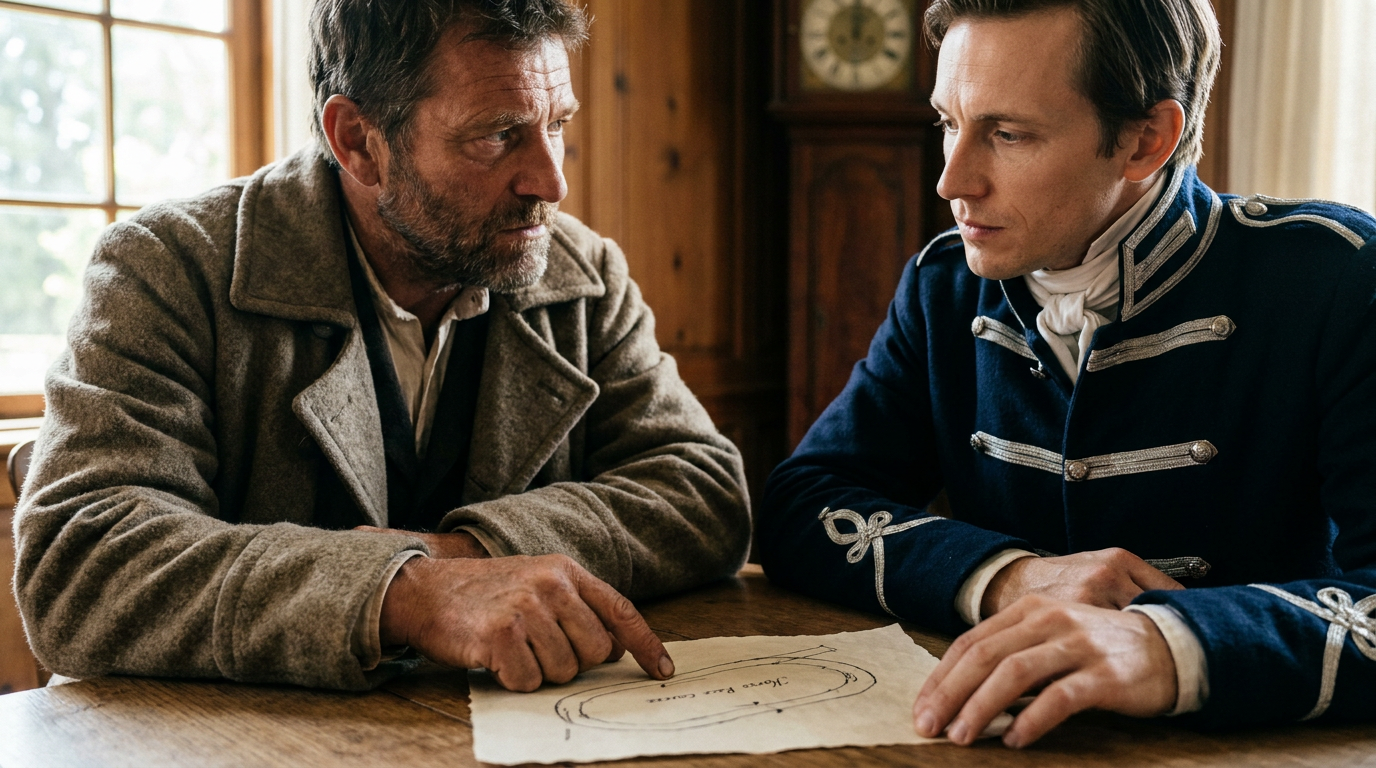
The plan drew on an older Munich horse-racing tradition, the Scharlachrennen, which had last been held in the eighteenth century. This was not a modern thoroughbred meeting with sponsor logos and television cameras. It was a public spectacle devised by local guardsmen for a royal wedding.
Dall’Armi eventually received Munich’s first gold citizens’ medal for helping create the festival. Baumgartner received a more immediate distinction: his horse won the first race. One man carried the proposal through the court; the other is credited in detailed Bavarian research with the suggestion and the winning entry.
What happened on Wednesday, October 17?
The location was open land beyond Munich’s gates, near the Sendlinger Berg. Contemporary race imagery and historical research show a course with the royal pavilion close to the action and spectators using the natural rise of the land for a view. Estimates commonly put the audience around 40,000, though a crowd that large in 1810 was not counted by a modern ticket system.
The pavilion deserves its own moment. Bavaria’s cultural archive describes a canopy 67 meters wide whose roof reused a historical war trophy taken in 1687. A royal tent, then, was on the grounds. What was absent was the landscape of enormous beer tents familiar to visitors today. The king and court watched from a privileged space even while the public shared the spectacle.
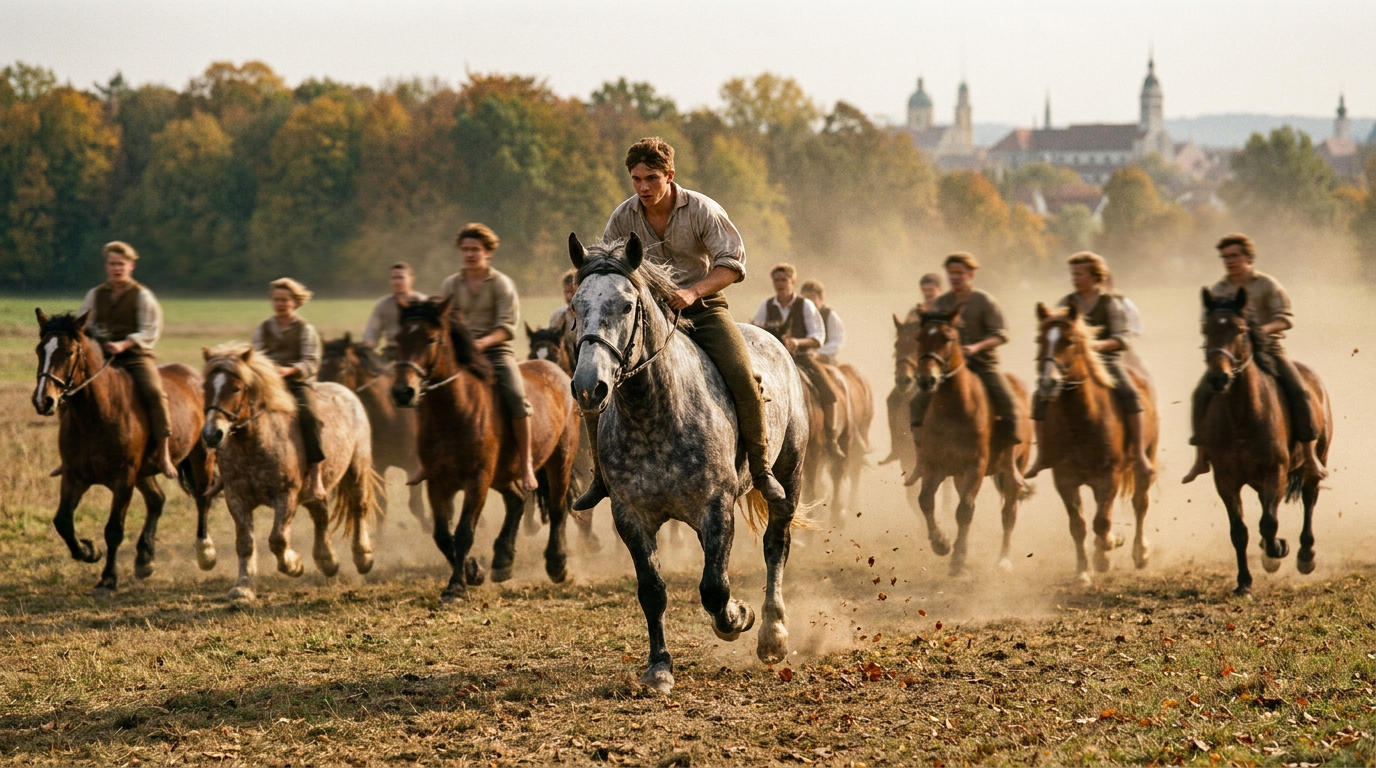
Records describe 30 horses entered in the race. Young riders, called Rennbuben, rode around the course three times. The horses were not a single modern branded breed; they were entries associated with their owners, including Baumgartner’s. An exact stable-by-stable list of origins and verified breeds is not available in the accessible sources used here.
A Munich historical archive describes the winning animal as a dapple-gray horse from Transylvania. According to that account, a boy of about twelve rode it without a saddle, finishing in 18 minutes, 14 seconds; Baumgartner, the owner, was credited as the winner. The rider’s personal name is not securely recorded in that account. “Dapple-gray” describes the horse’s coat, not its breed. The archive’s fine details are worth sharing as an attributed account, rather than presenting every one of them as a modern race result certified to the second.
How was the weather? The same local historical account calls it a mild autumn Wednesday. We do not have a verified temperature, hourly forecast, or proof of an uninterrupted blue sky for the race. A museum’s playful “live radio” reconstruction describes beautiful sunshine, but it explicitly imagines a broadcast that never existed. Treat its sky as storytelling, not a weather report.
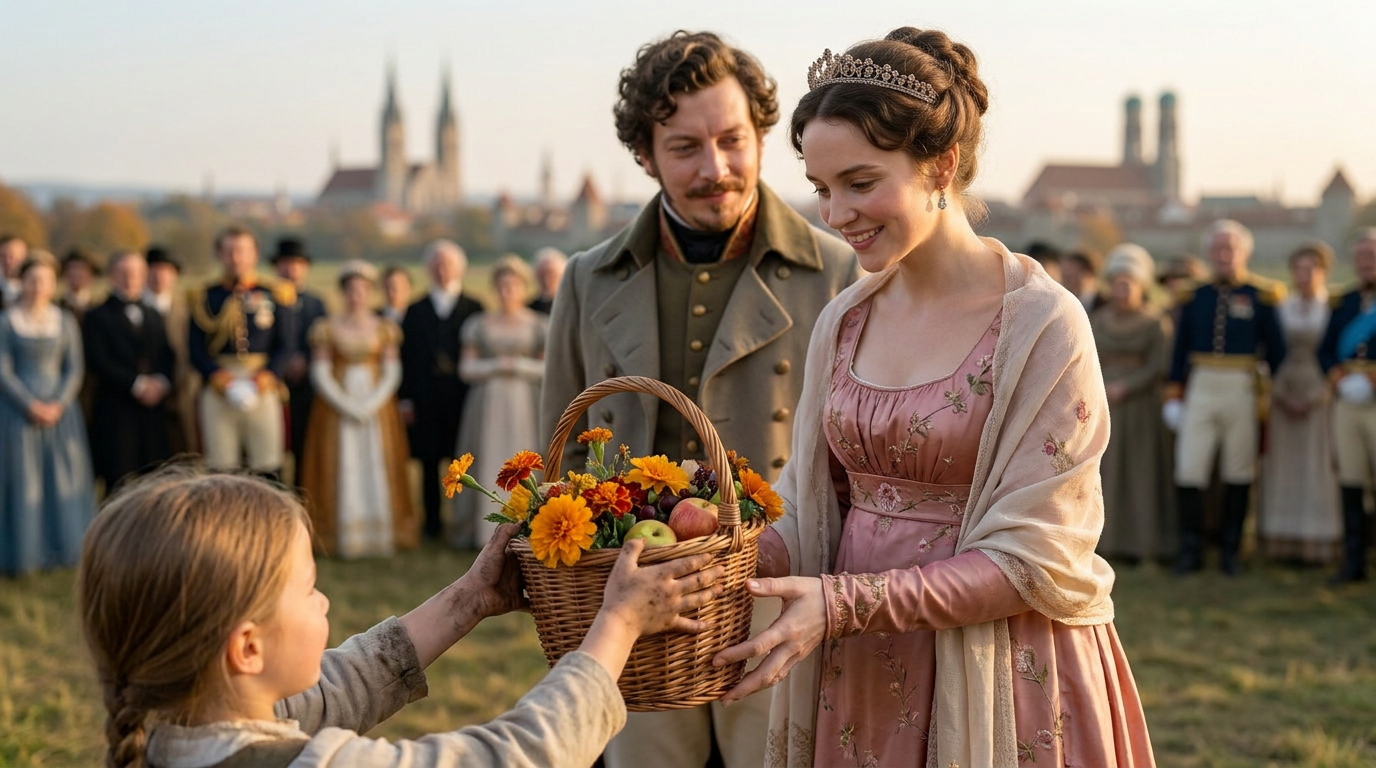
Children in Bavarian regional dress offered the royal family poems, flowers, and fruit. Think of the contrast: thunderous hooves, cheering spectators, and a child stepping forward with a bouquet. These are the human-scale details behind the phrase “the first Oktoberfest.”
When did it get its name?
On race day, the event was described as a horse race celebrating the crown prince’s marriage. The festivities in Munich were also called a Volksfest, a public or folk celebration. Calling October 17 “the first Oktoberfest” is accurate as a historical shorthand, but it applies a later enduring identity to an event whose organizers could not know it would become annual.
After the successful race, the field received permission to be called Theresens Wiese, “Therese’s meadow.” A Munich literary archive places Dall’Armi’s announcement to the guardsmen on the day after the race. The name gradually developed into Theresienwiese, shortened locally to die Wiesn.
What did people call the fall celebrations before the name settled? Early descriptions used names tied to the horse race, the royal wedding, a Bavarian national celebration, and, after the agricultural exhibition joined in 1811, the agricultural festival. The City of Munich describes the recurring events as the “Oktober-Feste.” An 1823 published work already bears a title meaning “The October Festivals on the Theresienwiese.” By 1831, composer Felix Mendelssohn used the spelling Octoberfest in a letter. These examples show a name taking hold over time; they do not identify a single person who coined “Oktoberfest” or one ceremonial date when a naming committee made it official.
The actual decision that made a tradition came in 1811: repeat the race and add an agricultural exhibition. Beer stalls, rides, and large halls followed in later years. The name stayed rooted in October even after the schedule shifted toward milder September days.
Where do brass bands, electricity, and Einstein fit?
Music was part of the 1810 wedding celebrations: bells, choral music, and trumpets are documented. A familiar tent band leading thousands through “Ein Prosit der Gemütlichkeit,” however, belongs to the later festival. Munich’s official Oktoberfest site dates a prominent 30-piece tent band and distributed sing-along books to 1898.
Electric light is another story with several dates, depending on what you mean by “first.” Research published by the Deutsches Museum records 16 arc lamps installed on the Oktoberfest grounds by Einstein & Cie. in 1885. Munich’s festival history also associates Einstein & Cie. with tent lighting in 1896. Electricity was therefore arriving in stages, not switched on across the entire festival in one night.
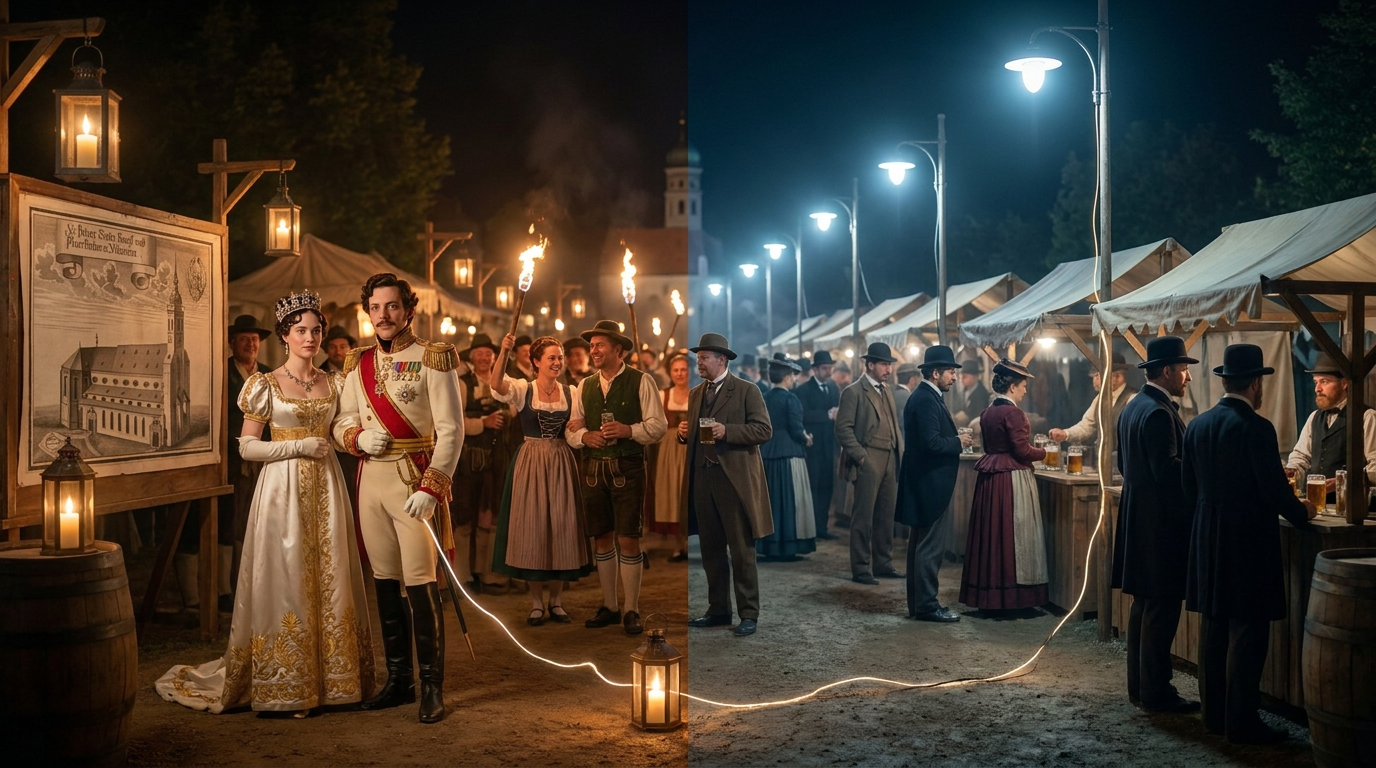
And Albert Einstein changing light bulbs? It is a delightful story. His father and uncle were involved in the electrical firm, and versions of the tale place young Albert helping at Oktoberfest. But even pages on Munich’s official festival site give conflicting years, while one explicitly says the legend cannot be proven or dated with certainty. Enjoy the possibility; do not caption an image “Albert Einstein changing bulbs in 1810.” He was not born until 1879.
The same care applies to the bride’s height, an exact wedding menu, named foreign dignitaries, and every horse’s breed. Historical curiosity is part of the fun; making up answers would make the real surprises harder to see.
The first Oktoberfest, in one unforgettable scene
Picture the newly married Ludwig and Therese in a royal pavilion beside an open course. Children bring flowers. Guardsmen manage a race suggested by a coachman and organized by his major. Thirty horses set off; Baumgartner’s entry wins. Beyond the meadow, Munich has spent days feeding, entertaining, and celebrating with its people. No one yet knows that the decision to repeat this gathering will give Therese’s meadow a place in world culture.
That is what really happened at the first Oktoberfest: a wedding on October 12, five days of celebrations, and a horse race on Wednesday, October 17, 1810.
The beer halls came later. The curiosity is already there.