
The Real Story of the German Christmas Pickle and Its American Start

GERMAN HERITAGE USA | AFFILIATE DISCLAIMER: This post may or may not contain affiliate links which means we may receive a commission for purchases made through links. We will only recommend products that we have personally used or that we truly trust. Learn more on our Private Policy and Disclaimer Page located under our Terms Of Service tab above.
Few Christmas ornaments carry the mystery, charm, and emotional weight and uncertainty of the so-called German Christmas Pickle, that green glass gherkin tucked deep into the branches of holiday trees across America. Children hunt for it each Christmas morning, hoping for a reward—an extra present, a year of good fortune, or simply the honor of “finding the pickle.”

But behind this playful ritual lies a story far deeper than a quaint holiday legend. Its roots stretch from Bavarian hillsides to the horrors of a Civil War prison, and from the craft villages of Germany to the bustling storefronts of America’s first nationwide retail empire.
This is the real story—part history, part heritage, part reminder of the human capacity for gratitude—even in the darkest places.
A Bavarian Soldier on American Soil
The heart of the Christmas Pickle story begins not with a myth, but with a man.
John C. Lower, born in Bavaria, immigrated to the United States before the outbreak of the American Civil War. When conflict erupted, Lower enlisted with the Federal Union forces, eventually serving as a quartermaster—a role steeped in logistics, resource management, and discipline.
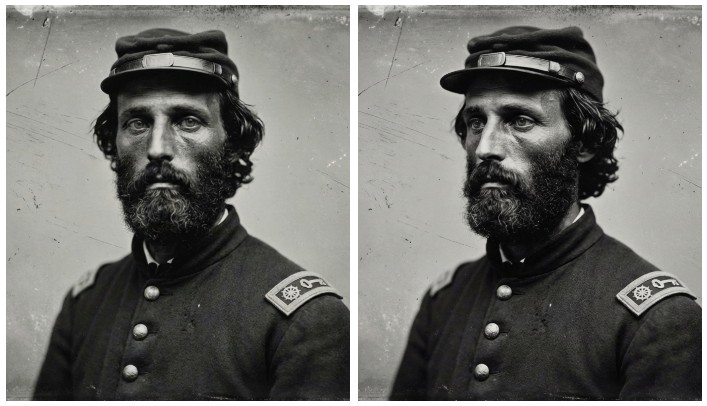
It is easy to imagine a young Bavarian immigrant believing that military service would both prove his loyalty to his adopted country and secure a better life after the war. Yet, as happens so often in history, fate carved a harsher path.
Captured in 1864, Lower was sent to Andersonville Prison—one of the most infamous prisoner-of-war camps in American history.
Andersonville: The Shadow of Suffering
Officially named Camp Sumter, Andersonville was designed for 10,000 prisoners. By the summer of 1864, it held more than 33,000. Disease, starvation, contaminated water, and exposure were daily realities.
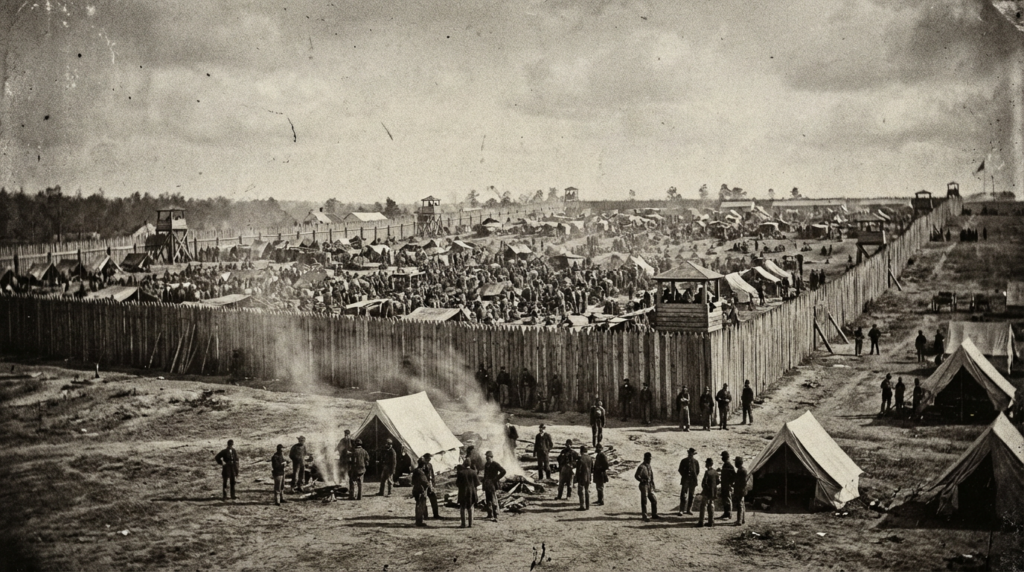
Survivors would later say that Andersonville pushed the human spirit to its edge.
“Each day felt like a negotiation between despair and determination,” one former prisoner wrote—a sentiment that captures the environment Lower confronted.
It was there, in the most unlikely of places, that a small act of compassion occurred—an act that would echo for generations.
The Pickle That Became a Lifeline
According to family accounts, passed down for decades, a Confederate guard noticed Lower’s deteriorating condition on a bleak Christmas Eve. Perhaps the guard saw a young man far from home. Perhaps hunger softened even the hardest wartime lines. Whatever the motivation, he offered Lower a simple pickle—half eaten, yet wholly meaningful.
It was not merely food. It was a reminder of humanity.

Lower reportedly later reflected that the unexpected gift gave him “a spark of hope I had not felt in months.” Whether from its nutrition or its symbolism, the pickle helped him regain strength. More importantly, it rekindled his will to survive.
This was the moment that transformed an ordinary vegetable into a symbol of gratitude, endurance, and new beginnings.
Return to Germany: A Tradition Begins
After the war ended and Lower was released, he eventually returned to Germany, settling in the beautiful historic town of Bamberg. There he resumed his trade as a blacksmith. He married, raised a family, and—like many who experience trauma—he built new meaning into old memories.
Each Christmas, Lower told his children the story of the pickle that helped save his life. And each year, he quietly began adding a pickle ornament to the family Christmas tree.
It was placed last.
It was hidden deep.
It was to be found only after every other gift had been opened.

Whoever discovered it earned a small extra present—or, in more modest years, Lower proclaimed that child would be blessed with “Glück im neuen Jahr,” good fortune in the coming year.
Thus the German Christmas Pickle tradition was born—not from ancient folklore, but from one man’s sincere act of remembrance.
A Twist of Fate: Lower and the Ornament Capital of the World
Lower’s relocation to Bamberg placed him just an hour’s journey from Lauscha, the now-legendary village in Thuringia that became the birthplace of modern Christmas ornaments. This geographic coincidence adds a beautiful layer to the story.
Lauscha craftsmen, dating back to the 16th century, perfected the art of glassblowing. But in the 1860s, glassblower Hans Greiner revolutionized the industry by creating thin-walled glass ornaments. These delicate, colorful pieces—angels, birds, fruits, and eventually pickles—quickly captivated Europeans.
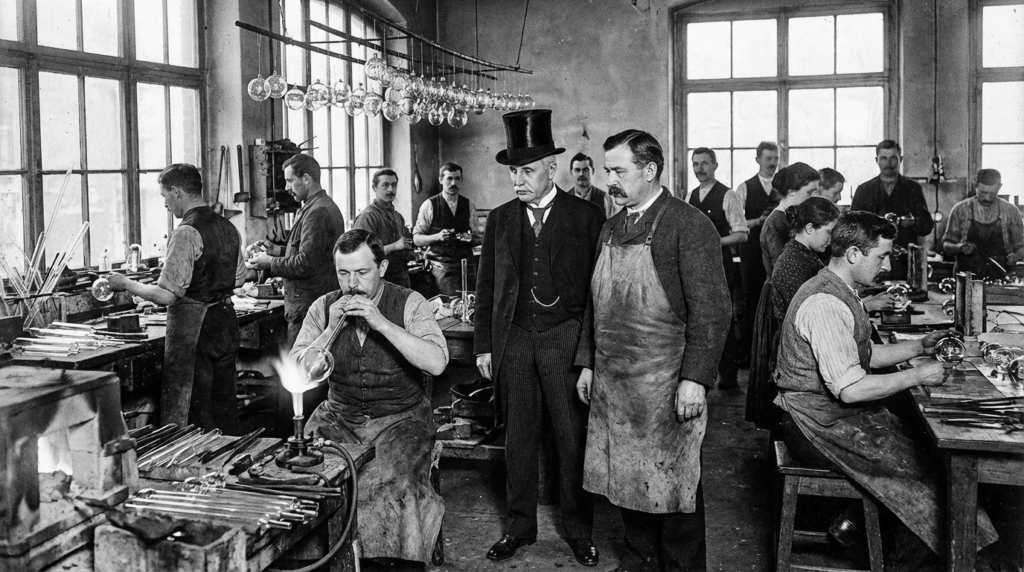
By the 1870s, Lauscha ornaments were exported worldwide.
By the 1890s, they were a sensation in America.
So as John C. Lower’s private family tradition unfolded in Bamberg, a broader global movement in German ornament production was blossoming around him. It is entirely plausible—perhaps even likely—that Lower purchased his family’s first pickle ornament from these very artisans.
Woolworth and the German Ornament Boom
If Lower planted the seed of the pickle tradition, F.W. Woolworth helped it grow across the Atlantic.

Woolworth, fascinated by the beauty and affordability of Lauscha glass ornaments, began importing them in the 1870s. In a remarkable business breakthrough, his stores sold millions of them—eventually shaping American holiday décor as we know it.
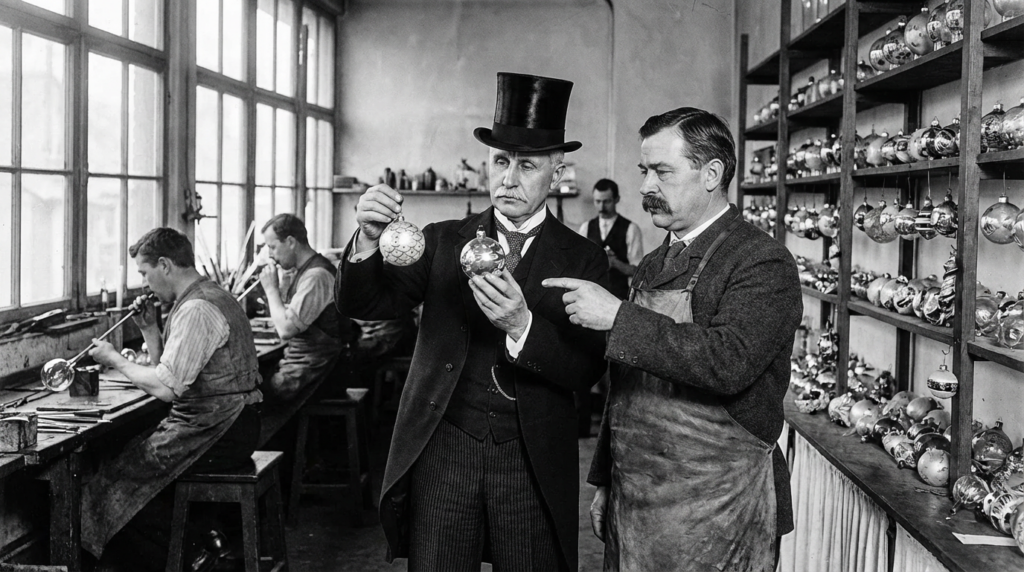
One Woolworth employee reportedly said:
“People didn’t just buy an ornament.
They bought a piece of Europe, a memory of home, or a dream of it.”
Among those ornaments were the quirky glass pickles that, decades later, American families would adopt as part of a holiday scavenger hunt. Many mistakenly believed it was an “old German legend,” though in truth, no widespread pickle tradition existed in Germany until after the American myth took hold.
Ironically, an American Civil War story helped popularize a “German” tradition that Germany later embraced.
Andersonville in Memory and History
The U.S. National Archives confirms that at least one John C. Lower survived captivity in Andersonville, and that his record matches the soldier later associated with the pickle story. Have we finally resourced the true story?
Another Pennsylvanian of the same name died earlier in the war, but the surviving POW—almost certainly our Bavarian-born Lower—lived until 1923, passing away at age 81.
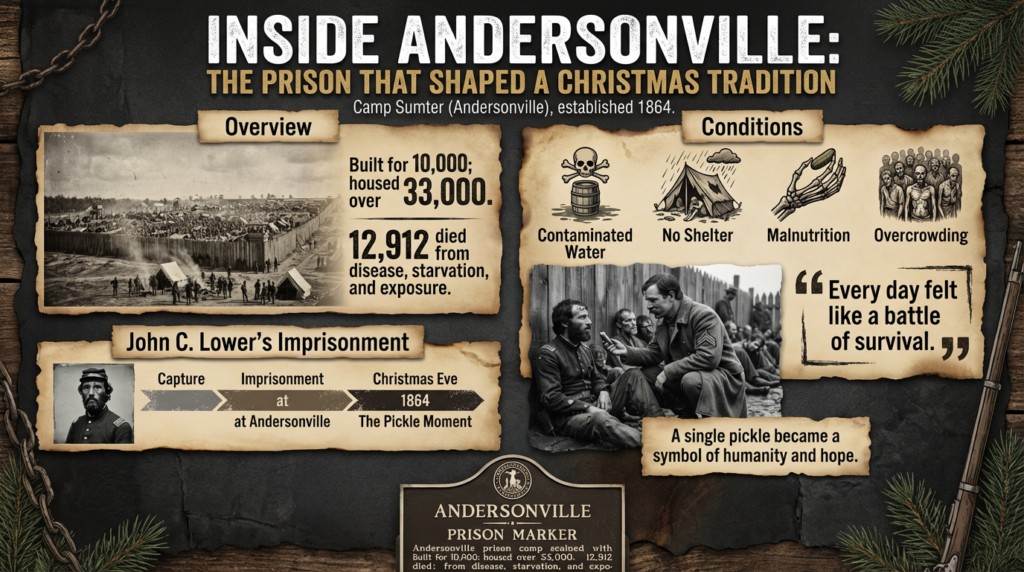
Today, Andersonville National Historic Site, established in 1917, preserves the prison grounds, a museum, and a solemn cemetery.
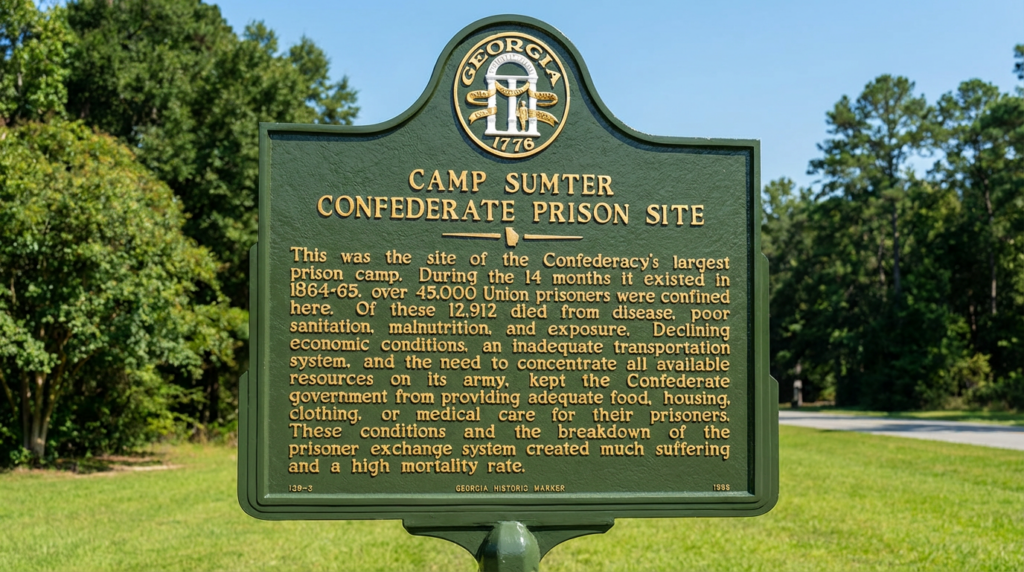
It stands not only as a reminder of the war’s brutality but also as a place where rare moments of humanity—such as the gift of a single pickle—still resonate.
The Pickle Today: A Symbol of Hope, Humor, and Heritage
The modern Christmas Pickle tradition serves several cultural functions:
1. A Link Between German Craftsmanship and American Custom
Even if the tradition is not widely practiced in Germany, Lauscha’s craftsmanship made it possible.
2. A Holiday Game Filled With Joy
Children adore the search. Adults relish remembering their own childhoods.
3. A Moral Legacy
Lower’s story reminds us that:
- compassion can appear in unexpected places
- hope can grow from the smallest gesture
- traditions can arise from deeply personal experiences
4. A Celebration of German-American Identity
Like many customs that crossed the Atlantic, the German Christmas Pickle carries the fingerprints of two cultures—German artistry and American storytelling.
A Tradition Rooted Not in Fantasy, but in Humanity
Unlike many Christmas legends, the story of the pickle does not hinge on magic or mythological figures. Its power comes from real people and real history:
A Bavarian immigrant.
A starving soldier.
A compassionate guard.
A simple pickle on Christmas Eve.
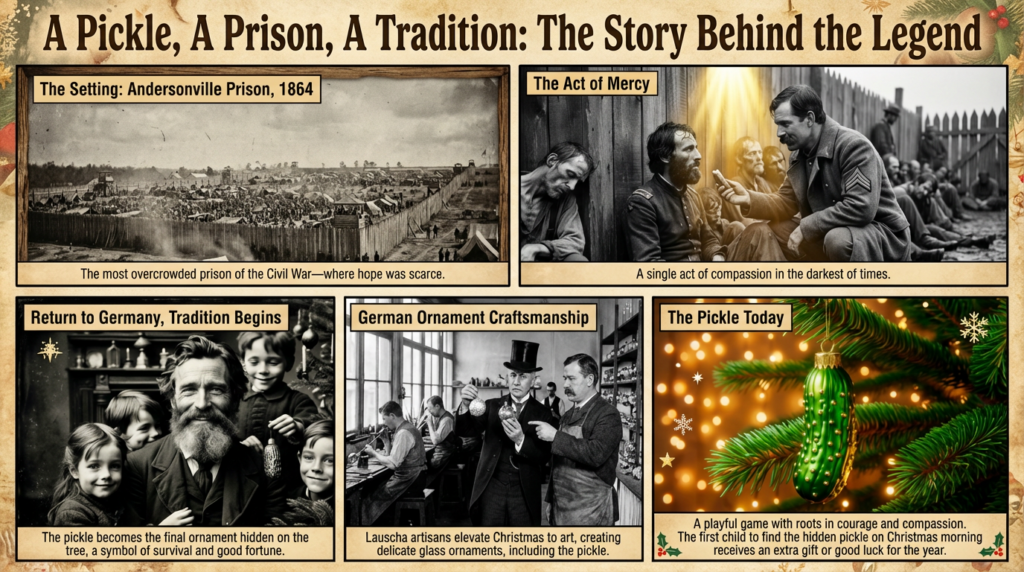
From this moment arose a family ritual, a cultural curiosity, and eventually a beloved holiday tradition celebrated in homes across America.
The pickle shines not because it is ornate, but because it represents:
- Survival in hardship
- Gratitude for mercy
- Remembrance of suffering overcome
- The blending of German and American histories
As one folklorist once remarked:
“Some ornaments reflect the lights of the tree.
But the Christmas Pickle reflects the resilience of the human spirit.”
Postscript: Bamberg, Lauscha, and the Path of Memory
After returning to Europe, Lower spent his remaining years in Bamberg, a town steeped in medieval charm and centuries of craftsmanship. Just a short trip north stood Lauscha, where the glass ornament industry thrived and where the Museum of Glass Art now preserves this remarkable heritage.
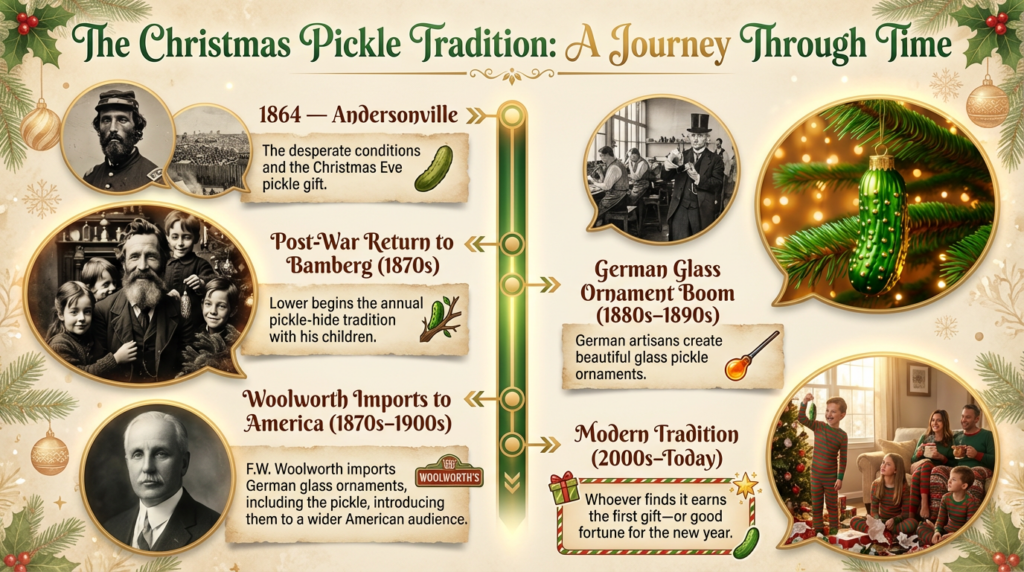
Bamberg represents the return to his native home. Lauscha represents new beginnings and the future. Andersonville represents the hardships one must overcome between the two. These three places—woven together in one man’s life—became the unexpected origin points of the Christmas Pickle tradition we cherish today.
Conclusion: A Pickle With a Purpose
When we hang a pickle ornament on our Christmas tree, we are doing more than participating in a holiday game. We are continuing a legacy forged from suffering, compassion, craftsmanship, and memory.
Lower’s story is a reminder that:
- Traditions often begin with real people, not ancient myths.
- Objects can carry the weight of history.
- Acts of kindness ripple across generations.
Every December, as you tuck a green glass pickle deep into the branches of your tree, pause and reflect:
A Bavarian soldier once held onto life because of a single pickle—and today, millions celebrate because his family chose to remember. If you love the idea of making the Christmas Pickle one of your own family traditions, CLICK HERE to order a pickle ornament to enjoy every Christmas season from this day forward… because you now know the true history and meaning of how it all started.

In its small, quirky way, the Christmas Pickle is not merely an ornament. It is a tribute to hope, faith, gratitude, and the enduring bond between Germany and America.

POST SCRIPT
The likelihood that Johann Christian Lauer served in the Union Army under the name John C. Lower is extremely high, and the transformation of his name fits squarely within well-documented Civil War–era practices affecting German immigrants.
Johann Christian Lauer was born in Bamberg, Germany, and by the outbreak of the American Civil War was living with family in Pennsylvania, a state with one of the largest and most established German-speaking populations in the United States.
When he enlisted in the Union Army, the American military system he entered was English-speaking, bureaucratically inconsistent, and dependent on clerks who often recorded names phonetically rather than formally or accurately.
Why Johann Christian Lauer became John C. Lower
The transition from Johann to John was nearly automatic. “Johann” was universally understood by English-speaking Americans as the German equivalent of “John,” and enlistment officers routinely translated it without asking.
The middle name Christian was commonly preserved only as an initial—especially in military paperwork where brevity and legibility mattered—resulting in “C.”
The surname shift from Lauer to Lower is particularly telling and historically credible. Unlike dramatic name changes driven by choice, this alteration almost certainly resulted from phonetic interpretation.
Spoken aloud in a German accent, Lauer (roughly Low-er) would have sounded indistinguishable from Lower to an English-speaking clerk. Once written that way on an enlistment roll, the spelling would propagate through:
- muster rolls
- pay records
- quartermaster accounts
- POW registers
- postwar pension and archival indexes
In the 1860s, there was no centralized correction mechanism. A man became, on paper, whatever the Army first called him.
Why the name stuck during service
Johann—now John C. Lower—served as his unit’s Quartermaster, a position requiring literacy, numeracy, and trust. Quartermasters generated enormous amounts of paperwork: receipts, inventories, requisitions, transport logs.
Consistency of name mattered more than personal preference. Once “John C. Lower” was established in official ledgers, changing it would have caused confusion or suspicion. For a German immigrant in wartime America, administrative conformity equaled safety.
Capture and confirmation
In April 1864, Private John C. Lower of the 103rd Pennsylvania Infantry was captured and sent to Andersonville Prison. Confederate prison records, like Union ones, relied on copied rolls and phonetic spelling.
POW lists were especially prone to errors—but they were also frozen in time. A name entered at capture followed a man through captivity, exchange lists, and survival records.
This is where the archival evidence becomes compelling.
A search of the National Archives reveals seven soldiers named John C. Lower who served during the Civil War. Only two were from Pennsylvania:
- One died of pneumonia in 1862
- The other survived captivity after being imprisoned at Andersonville
That second individual aligns precisely with Johann Christian Lauer’s known narrative.
After the war: reclaiming identity
Following the war, Lower returned to Germany, settling once again in Bamberg, where he worked as a blacksmith until his death in 1923 at age 81.
Back in his homeland—where there was no bureaucratic reason to maintain an Anglicized military identity—he resumed life under his given German name.
This pattern was not unusual. Many immigrants who returned to Europe after American service left behind their Anglicized identities as artifacts of necessity, not self-erasure.
Cultural and geographic echo
Just 57 miles north of Bamberg lies Lauscha, Germany, now home to the Museum of Glass Art, a reminder of the deep German craftsmanship of traditions, ornaments, metalwork, glass—that shaped communities like Johann’s both before and after the war.
His life bridged two worlds: German trade tradition and American military service, tied together by a name that shifted to meet circumstance.
Final assessment
Taken together—
- the common Anglicization of German names
- the phonetic evolution from Lauer to Lower
- the administrative inertia of military records
- the precise match of POW and Pennsylvania archival data
—it is historically sound and highly probable that Johann Christian Lauer and Private John C. Lower are the same man.
The name change was not deception.
It was translation, convenience, survival, and record-keeping—combined.
In uniform, he was John C. Lower.
In heritage, trade, and final rest, he was Johann Christian Lauer.
____________________________________________________________________
Portions of our videos and blog content may include image, video, or audio elements enhanced or interpreted by artificial intelligence for entertainment and educational purposes. Also, there may or may not be affiliate links to connect to Amazon for specific items for purchase that we may make a small commission on.